The 92 Threshold: Why Uncertainty is the Silent Killer of Small Business Growth
By Corey M. Girman, Principal | North Hill FLW
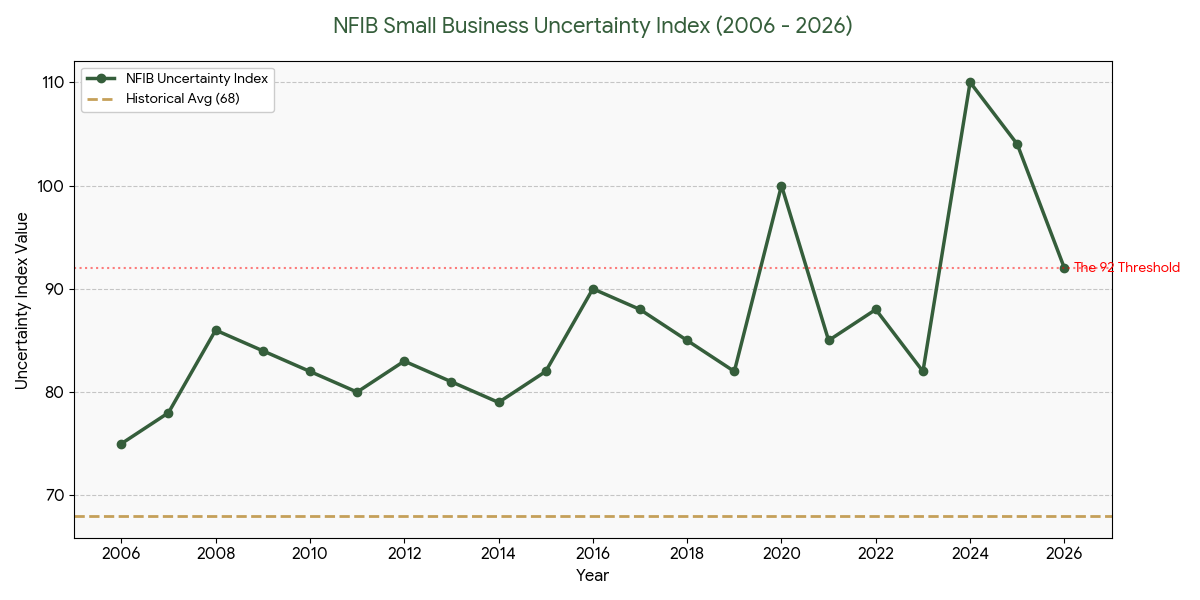
The April 2026 NFIB Uncertainty Index spike to 92—well above the 68-point average—signals a critical "Red Zone" for small businesses. When uncertainty is this high, expansion feels like gambling, leading to a net -25% profit trend and record-low capital investments. To survive, firms must pivot from macro-worry to micro-optimization through Human Automation and system resilience.
Every small business owner knows the feeling of driving through a heavy fog. You can see the hood of your truck, but you can’t see the turn coming in fifty yards. You tap the brakes. You slow down. You wait for a clearing.
In April 2026, that fog just became a blackout. The latest NFIB Small Business Economic Trends report shows that the Uncertainty Index has spiked to 92. For context, the 52-year historical average is 68. We aren't just "unsure" anymore; we are operating in a psychological red zone where the math of growth no longer adds up.
As the Principal of North Hill FLW, I look at this data through a COO’s lens. I don't care about academic theories; I care about the systems that keep your LLC breathing. And right now, the data tells us that uncertainty isn't just a feeling—it’s a silent killer of the American backbone.
Why does the 92 Threshold turn business expansion into gambling?
When the Uncertainty Index hits 92, the "risk premium" for every decision you make skyrockets. Usually, expansion is a calculated move. You look at your pipeline, you look at your cash flow, and you pull the trigger on a new hire or a second location.
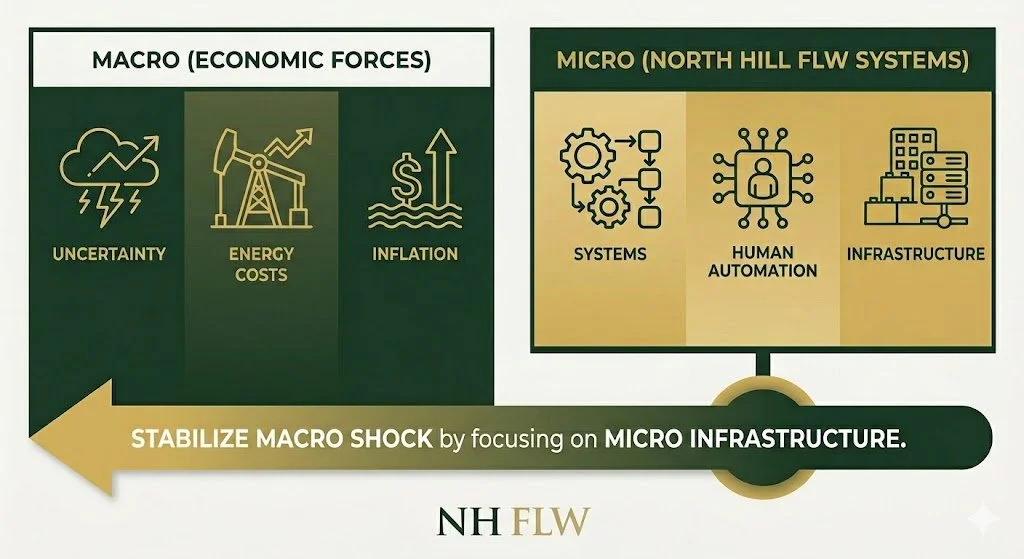
But at 92, that calculation breaks. Because the macro environment—inflation, energy costs, and regulatory shifts—is so volatile, you can’t accurately predict your ROI. In this environment, "expansion" feels like "gambling." And as business owners, we aren't here to play craps with our employees' livelihoods. We hunker down. We wait. But "waiting" has a cost, and that cost is the stagnation of Main Street.
How are bleeding margins and low capital outlays stalling the economy?
The April report highlights a brutal reality: profit trends have plummeted to a net negative 25%. This is the single biggest contributor to the decline in the Small Business Optimism Index.
We are caught in a classic "Inflation/Energy Squeeze." Small businesses are the shock absorbers of the economy. When input costs rise, we try to absorb them to stay competitive. But there’s only so much blood you can squeeze from a stone. Eventually, those costs have to be passed to the consumer, or the business bleeds out.
The result? Capital Expenditures (CapEx) have cratered. Only 16% of owners plan to make capital investments in the next few months. That is the lowest level we’ve seen since the 2009 Great Recession. When owners stop buying equipment, upgrading software, or expanding footprints, the engine of the economy starts to seize.
Why is "Technical Debt" the real multiplier of economic pain?
Here is where my perspective as a Fractional COO differs from a standard economist. I believe the "92 Threshold" is dangerous because it exposes Technical Debt.
Technical Debt is the cost of all the manual workarounds, messy spreadsheets, and broken processes you’ve ignored while times were good. When the economy is booming, you can afford a little "system friction." But when margins are bleeding at -25%, that friction becomes a tax you can no longer afford to pay.
Uncertainty acts as a multiplier. If your internal systems are inefficient, a 10% increase in energy costs feels like a 30% hit to your sanity. You are fighting the economy and your own infrastructure at the same time. This is why firms that haven't invested in Human Automation are the first to crack under the pressure of the 92 Threshold.
How can Human Automation bridge the gap for North Hill FLW clients?
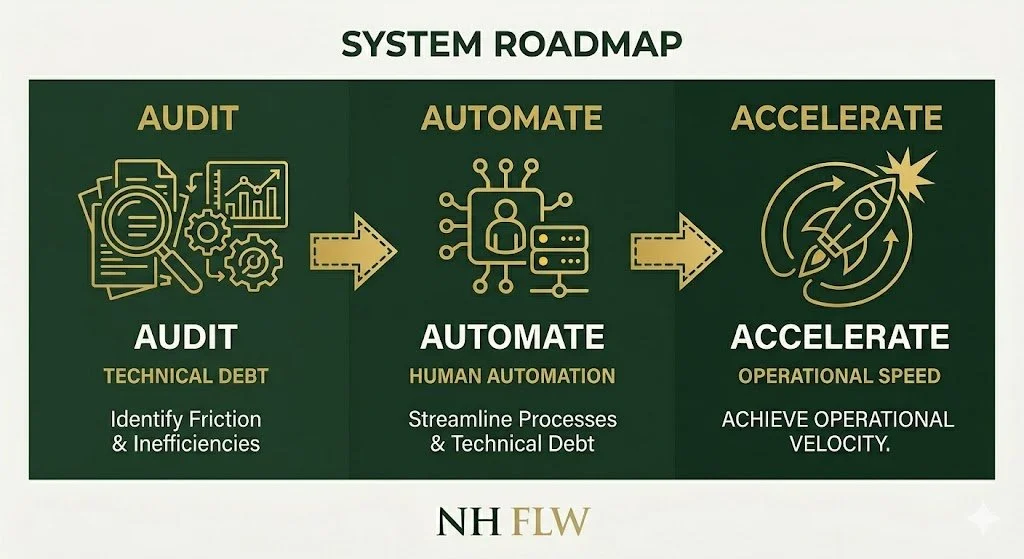
At North Hill FLW, we tell our clients: You cannot control the NFIB report, but you can control your backbone. The solution to high-level uncertainty isn't to stop moving—it’s to move more efficiently. We focus on Human Automation and Fractional Operations to clean up the technical debt that’s dragging you down. By automating the "robotic" parts of your business, we free up your humans to do what they do best: solve problems and care for customers.
When the "fog" of 92-level uncertainty clears—and it eventually will—there will be two types of companies:
Those that stood still and let their systems decay.
Those that used the downtime to build a high-performance engine.
We want you to be the latter. Resilience isn't just about "hanging on" until things get better; it’s about utilizing systems architecture to ensure you are the most agile player in the room when the market turns.
Conclusion: A Rallying Cry for the Backbone
The 92 Threshold is a warning, not a death sentence. Yes, the margins are tight. Yes, the "fog" is real. But this is the time to lean into your systems. While your competitors are paralyzed by the NFIB data, use this moment to audit your infrastructure. Build a better backbone. Automate the friction.
Small businesses win when they are too agile to be caught by macro trends. Let’s get to work.
Data & Methodology
This analysis is based on the April 2026 NFIB Small Business Economic Trends report. North Hill FLW utilizes primary economic indicators to help small firms navigate technical debt and operational scaling.
Primary Source: NFIB April 2026 Report – Full Data Set
2026 Small Business Economic FAQ
What does an NFIB Uncertainty Index of 92 mean for my business?
It means the economic "fog" is at a 52-year high. At this level, traditional growth strategies carry higher risk. Owners should focus on maintaining liquidity and optimizing internal systems rather than high-risk physical expansion until the index trends back toward the historical average of 68.
Why are profit trends currently at a net negative 25%?
Small businesses are currently caught in an "Inflation/Energy Squeeze." Owners are absorbing higher input and labor costs to avoid losing customers, which is "bleeding" their margins. This decline is the primary driver of the current drop in the Small Business Optimism Index.
How does "Technical Debt" affect my resilience in 2026?
Technical Debt—manual processes and outdated systems—acts as a multiplier for economic stress. When margins are thin, the time and money wasted on inefficient workflows can be the difference between staying solvent and closing doors. Cleaning up this debt is essential for survival.
What is the benefit of Fractional Operations during high uncertainty?
Fractional Operations allow small firms to access high-level COO expertise and Human Automation systems without the cost of a full-time executive. This provides the "backbone" needed to scale efficiency and reduce costs during volatile economic periods.
